Define the problem
Frame the decision, constraints, available data, and what a useful answer must change.
RAN Technologies explores relational intelligence, coherence, correlation geometry, and emergent structure across computational and physical systems.

The wider research ecosystem behind RAN Technologies.
RAN is being developed for environments where meaning lives in changing relationships, not isolated values.
Four connected programs investigate how useful structure can be discovered, represented, tested, and revised through relationships rather than isolated observations.
The core computational technology for evaluating coherent relational structure in complex information environments.
Core technologyThe developing architecture for pathway testing, persistent anomalies, local uncertainty, and revision without erasing history.
Active developmentThe geometry layer for representing relationships, observer-conditioned paths, and coherent configurations.
Geometry engineFoundational research into relational descriptions of time, geometry, physical structure, and emergent spacetime.
Foundational researchThe public architecture is deliberately high-level. It shows the research flow without publishing implementation mechanics or patent-sensitive details.
Choose a controlled test case and run the public demonstration. These are frozen r1 research outputs presented through a simplified website interface. The full RAN system includes deeper controls, provenance review, reliability links, persistent history, and private implementation logic not exposed here.
RAN is designed around the structure of evidence: where it came from, whether it is truly independent, what it supports, what contradicts it, how reliable it remains, and whether the evidence has actually earned a resolution.
Five reports repeating one source do not become five confirmations. RAN tracks provenance and dependency so copied evidence cannot manufacture consensus.
Conflicting evidence is not averaged away or silently overwritten. It remains attached to the part of the field it contests and can trigger further testing.
If evidence becomes less trustworthy, RAN reduces its authority. It does not automatically turn that weakness into proof of the opposite explanation.
RAN can preserve competing explanations when the evidence has not earned a unique resolution. Ambiguity remains explicit instead of being hidden.
A hypothesis can lead while RAN still refuses to call the case resolved. The strongest current path and a justified conclusion are not treated as the same thing.
When the field remains unresolved, RAN identifies the next observation most capable of separating the surviving paths instead of merely saying “more data needed.”
RAN is tested against real degradation, prognostics, and dynamic-market data. The public record shows the questions being asked, the evidence produced, and the limits of each result. Quantitative claims are added only when they are supported by documented, repeatable runs.
Versioned testing against bearing-degradation data to evaluate whether relational structure can expose useful degradation pathways and failure behavior.
Development records include iteration, anomalies, and revision history.Cross-domain testing against turbofan prognostics data to challenge generalization beyond a single degradation environment.
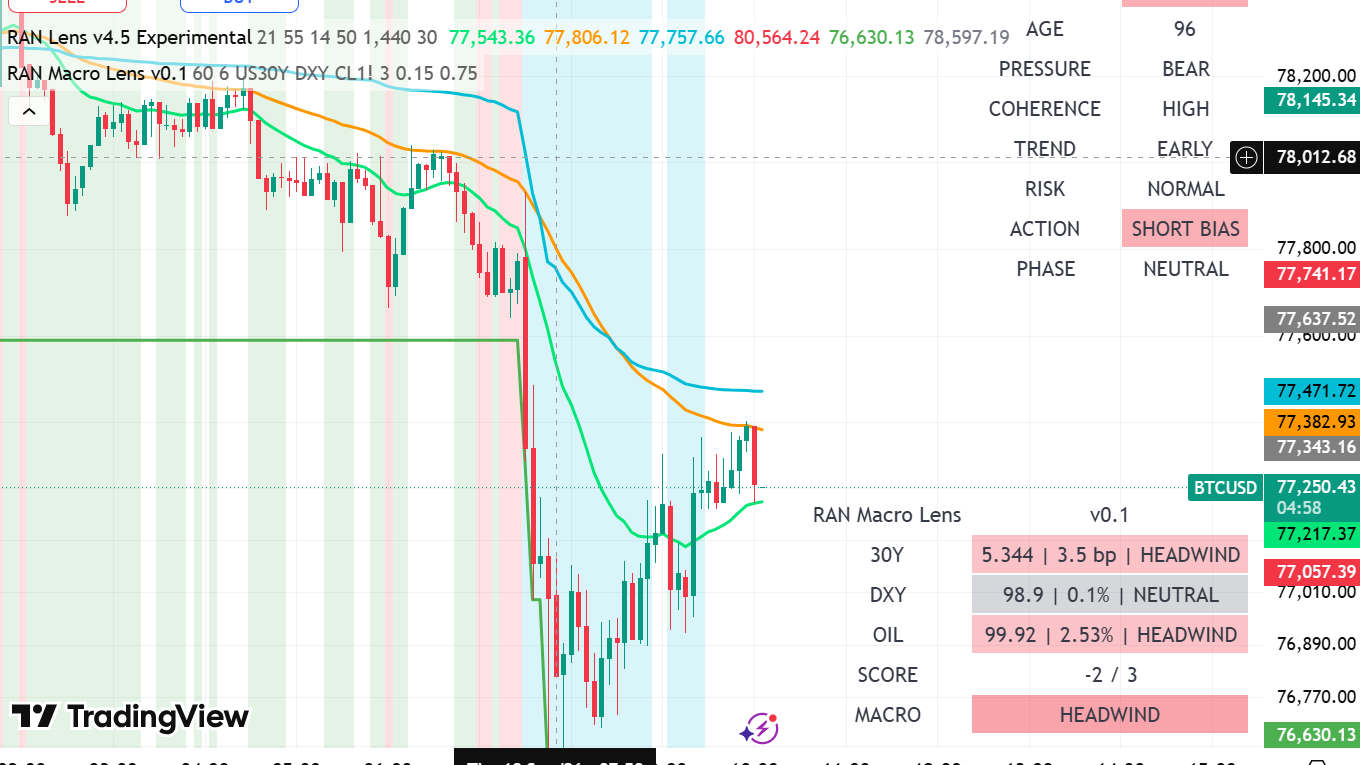
Results remain in technical validation; unsupported performance claims are intentionally omitted.RAN has been used as a confirmation layer against independently identified BTC price structure in live and historical chart studies.
The lens is an experimental application, not a claim of guaranteed prediction.Bitcoin price behavior provides a live, noisy environment for testing whether relational-state changes can add useful confirmation around independently defined market structure.
This is an experimental dynamic-systems study, not a claim of guaranteed prediction or investment performance.
Each RAN architecture is evaluated with versioned experiments, multivariable real-world data, comparison baselines, and visible failure cases. Public materials explain what was tested and what the result earned while protected implementation mechanics remain private.
A separate public-safe technical brief documents the problem, architecture, test domains, research method, development record, and current limitations without disclosing patent-sensitive mechanics. Request a copy through the business contact below.
A focused RAN pilot starts with one consequential problem, maps the competing relational paths, and delivers an evidence-backed recommendation for the next test.
Frame the decision, constraints, available data, and what a useful answer must change.
Expose supporting, contradictory, and missing relationships across the system.
Receive a concise evidence map, interpretation, and a practical validation step.
RAN Technologies is founder-led by an applied technical practitioner with experience in industrial maintenance, equipment failure investigation, root-cause analysis, field operations, crew leadership, and the training, evaluation, or certification of more than 1,000 personnel.
RAN's technical research and its philosophical writing are kept deliberately separate. The books explore questions of distinction, awareness, coherence, time, and stillness without publishing implementation details.

An early philosophical exploration of whether time is fundamental, or whether it emerges from the way awareness encounters change, relation, and existence.
“Time does not pass. Awareness does.”
A philosophical exploration of distinction, awareness, coherence, time, and stillness — written as a companion to the broader relational research program.
A contemplative exploration of stillness as completion rather than absence, and the boundary where no new relational distinction remains.
RAN Technologies currently has two active U.S. patent applications. Public communication is intentionally separated from claim-relevant implementation detail, unpublished equations, and internal test logic.
The public site communicates problems, architecture at a safe level, test domains, documented evidence, and research direction.
RAN Technologies LLC maintains an active intellectual-property program. Public materials intentionally omit unpublished implementation mechanics, claim-relevant detail, and protected development logic.
For paid pilots, research collaboration, licensing, validation, or technical inquiries, contact RAN Technologies directly.